
The six areas we cover
A vibecoding workshop for your team
We will teach you to program with the help of artificial intelligence
A one-day or two-day practical workshop on how to let AI write code without losing control of the result. For groups of up to 15 people, right at your company.
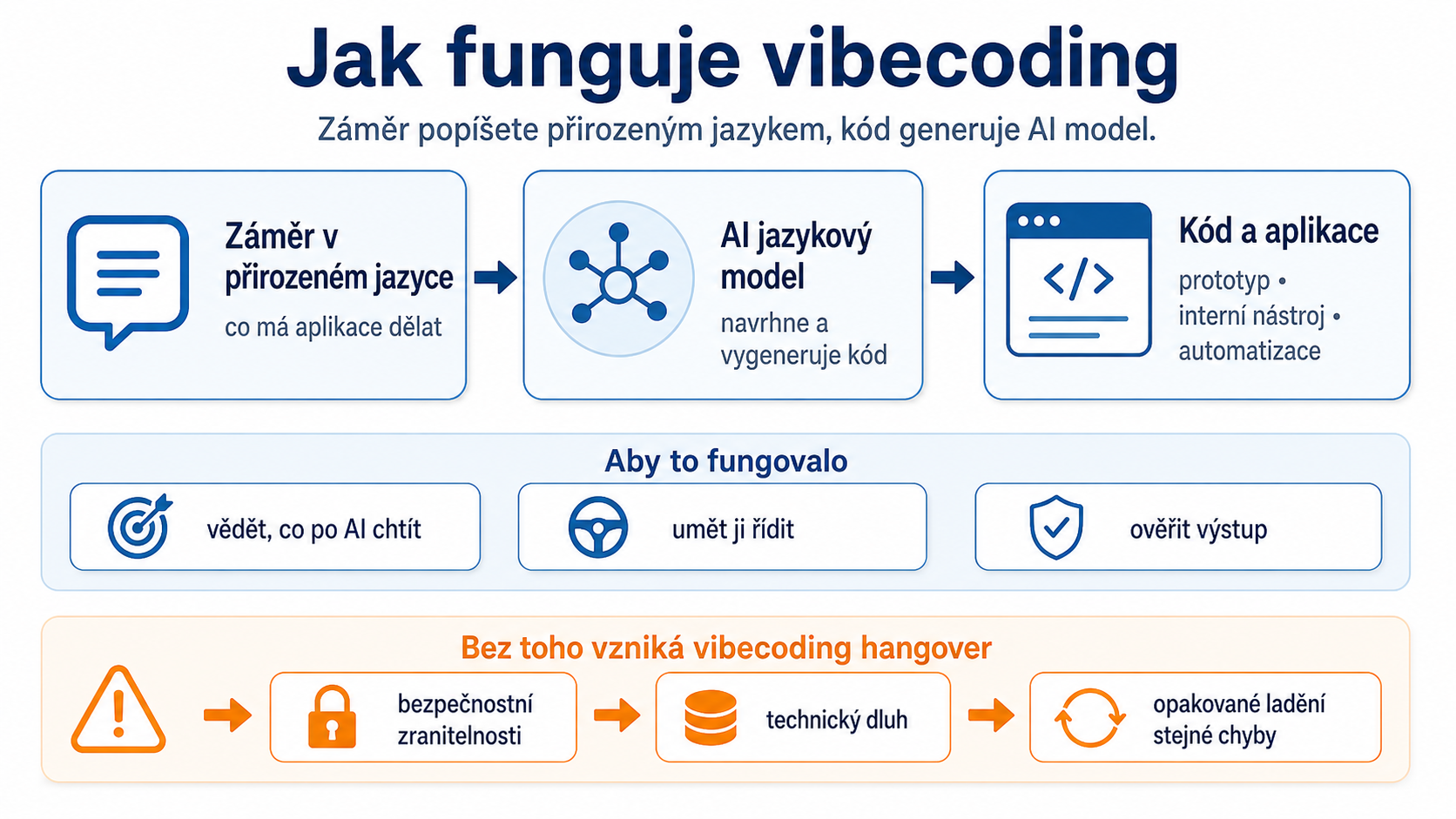
Vibecoding is a new route to programming in which you describe your intent in natural language and the code is generated by an AI language model. It works well for prototypes, internal tools and automations, but only when you know what to ask the AI for, how to steer it and where to verify the output. Without that, every second project ends in the so-called vibecoding hangover: security vulnerabilities, technical debt and repeatedly debugging the same error.
Without control, vibecoding quickly turns into gambling
When enthusiasm about how fast AI writes code overrides professional discipline, the result shows up in the figures now published by security firms and code review platforms.
- 45 % of AI-generated code contains security vulnerabilities (Veracode, 2025)
- 1,7× more serious bugs in AI-coauthored code compared with classic development. (CodeRabbit, analysis of 470 PRs)
- +74 % more configuration errors in projects built with AI without supervision. (CodeRabbit, 2025)
 The workshop is led by Michal Kubíček – a consultant and programmer with more than 20 years of practice in digital marketing, development and automation. He will teach your people to work with vibecoding professionally: from choosing the right language and tool, through the specification and the plan, to secure versioning, review and deployment.
Who is the workshop for?
Non-technical teams and product managers
If you want to build prototypes, internal tools and automations yourself without waiting for the development team, we will teach you when AI serves as a real collaborator and when it is merely a fast route to an expensive mistake. The emphasis is on the specification, the plan and checking the output, not on writing the code itself.
Beginner and junior developers
If you already do some programming and want to work with AI professionally, you will get a complete workflow from product-spec.md through the implementation plan to review and versioning. We focus on tools such as Claude Code, Cursor and Codex and on the common error patterns a beginner cannot avoid on their own.
Team leaders and CTOs
If you are introducing AI into development and looking for a minimum set of rules for safe work, you will take away concrete templates - product-spec.md, implementation-plan.md, a review checklist - and a role model for the planning, implementing and reviewing agent.
What you will learn at the workshop
What vibecoding is and where it ends
Andrej Karpathy’s definition, Simon Willison’s critique and a practical distinction between vibecoding, AI as a programming assistant and classic development. You will understand when each approach is appropriate and why.
Programming languages for the AI era
Python, JavaScript/TypeScript, PHP, SQL, HTML/CSS – what suits what, what it needs in order to run and where you deploy it. Including the decision logic for choosing a stack according to your infrastructure (WordPress hosting, shared hosting, VPS, cloud).
A map of the tools
Vibe coding apps (Lovable, Replit, Macaly, v0, Bolt) versus AI coding agents (Cursor, Claude Code, Codex, ChatGPT/Claude.ai chat). Who they are for, what their main strength is, and a recommended path for a beginner through four successive steps.
Best practices for working safely with AI
The vibecoding doom loop and how to avoid it. Plan-Review-Fix and Implement-Review-Fix cycles according to Teresa Torres. Versioning through Git as a lifebelt, skills as reusable instructions, project memory, context rot and the diagnose-then-fix strategy.
Specification and plan before code
The product-spec.md and implementation-plan.md templates you give the agent before the first line of code. Iterating in markdown, the plan reviewer as a fresh pair of eyes, red flags in the plan, acceptance criteria.
The three layers of software: data, controller, view
A mental model that saves hours of debugging. A practical test of where each change belongs. Why AI most often goes wrong precisely at the boundaries between layers and how to force it in the prompt to go through all three.
How the workshop runs
The workshop is always structured, but we tune it to your needs, your field and the maturity of the team. Before the workshop we clarify with you what you actually work on, which tools you have available and where you see the biggest blind spots. Based on that I adjust the proportions between theory, demonstrations and independent work.
One-day workshop
6–7 hours of net time + breaks
A compact run through all six topics, with an emphasis on understanding the principles and on a practical demonstration. Towards the end of the day participants try building a simple application according to a prepared specification and go through the Plan-Review-Fix cycle.
Suitable if you want to give the team basic orientation in the terminology, tools and principles, so that they know what to ask AI for and where to look for more.
Price: CZK 40,000 excl. VAT (CZK 48,400 incl. 21 % VAT)
Two-day workshop
2× 6–7 hours of net time + breaks
A deeper format with an extended practical part. The first day is theoretical and practical (languages, tools, layers, doom loop). The second day is entirely devoted to independent work: every participant goes through the whole cycle from specification through the plan and implementation with an AI agent to review and commit. At the end of the second day every participant has their own working mini-project deployed to a URL or in a repository.
Suitable if you want the team to take away real skills and templates they will start using the very next Monday.
Price: CZK 80,000 excl. VAT
The price is per group of up to 15 people and includes preparation of the workshop, the lecturer's guidance, online materials, the product-spec.md and implementation-plan.md templates, and 30 days of email support for questions that come up during the first month of practice.
What will you take away?
The ability to choose a tool by the task, not by the hype
After the workshop your people will know the difference between Lovable, Cursor and Claude Code, they will know when to use which, and they will not blindly follow whatever happens to be popular on LinkedIn.
Concrete templates they will start using straight away
The product-spec.md template, the implementation-plan.md template, a review checklist, prompts for the planning and reviewing agent. All in markdown format and with the expected outputs explained.
A workflow that still holds up months later
A branch before the agent, small commits, a diff before the commit, no secrets in the repo, a test before the merge, a rollback plan. The minimum of git discipline that turns vibecoding from gambling into a professional tool.
There are many AI training courses on the market today. Most of them, however, deal with the general use of ChatGPT and avoid the specific technical questions that vibecoding brings. This workshop is different in four ways.
Built on primary sources. The content draws on the current practice of Andrej Karpathy, Teresa Torres and Simon Willison and on the internal best practices of Anthropic, OpenAI and Vercel. No recycled marketing.
It is led by an active practitioner, not a career lecturer. Michal Kubíček builds AI agents, WordPress plugins, automations and his own web applications every day. The examples you will see at the workshop come from real projects, not from documentation.
It targets corporate reality, not hobby projects. The emphasis is on secure deployment, versioning, review and the limits of AI’s responsibility. The things you need to deal with when your app is to run at a customer’s site, not on a personal laptop over the weekend.
In plain language, with local examples and a concrete stack. WordPress hosting, Forpsi, Wedos, shared hosting in the Czech Republic – this reality is missing from most foreign materials. The workshop takes it into account.
Frequently asked questions about vibecoding
Do participants need to know how to program?
No. The workshop is designed so that both beginners and junior developers leave having gained something. With non-technical participants we focus more on specification, choosing tools and checking the output; with the more technically advanced we add more about agentic workflows and versioning. We tune the group according to the entry questionnaire that you fill in before the workshop.
How many participants can take part?
The price applies to groups of up to 15 people, which is the upper limit for meaningful interaction and the practical part. For larger groups we recommend splitting the workshop over several days or adding an assistant trainer – in that case the quotation is individual.
What about the venue?
The workshop takes place at your company on an agreed date. If you do not have your own meeting room, we have our own training premises in Ostrava. In other locations (Prague, Brno and elsewhere) we will arrange them; the rental cost is dealt with separately.
What if only a few of us turn up?
The price is for the workshop, not per participant. Whether 5 or 12 people attend, the price is the same. We have no lower limit – the workshop makes sense even for a small team of 3–4 people.
Can we obtain a subsidy through the Labour Office, the Ministry of Labour and Social Affairs or business vouchers?
Mediatoring.com s.r.o. is an accredited supplier for the business vouchers project and a provider of creative vouchers. In certain cases the workshop can be financed from these programmes – when you enquire we will be happy to explain whether your case meets the conditions and whether any of the authorities is currently offering a suitable subsidy programme.
Can the workshop be held online?
Yes, but we recommend the in-person format. The practical part with the Plan-Review-Fix cycle and peer review between participants works considerably better live. We offer the online version at the same price, but with the caveat that some of the interactivity is inevitably lost.
Do you issue a certificate of completion?
Yes. After the workshop every participant receives confirmation – a certificate of completion – which can be used for internal HR purposes.
Related services
AI implementation and training
We teach your team to use AI so that something actually changes in the company.
AI agents, workflows and scripts
We take over repetitive work: agents and workflows connected to e-mail, ERP and e-shop.
Subsidised courses and training
AI and digital-skills courses with subsidy support – for individuals and company teams.